
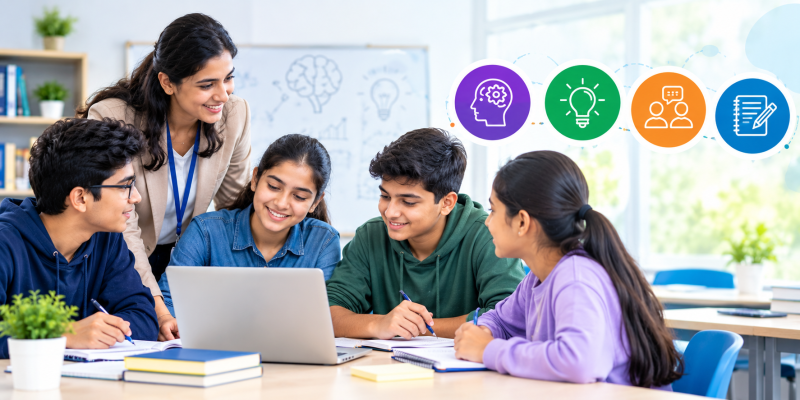
Academic knowledge provides an important foundation, but success in the future also depends on how well students think, communicate, learn, and respond to challenges. Parivarrtan’s Future Readiness Workshops are designed to help students develop these essential skills in a practical and engaging way.
The workshops encourage students to look at situations from different perspectives, ask thoughtful questions, analyse information, and make reasoned decisions. Through interactive activities and real-world situations, students learn that problem-solving is not always about finding the quickest answer—it is about understanding the problem and choosing an effective approach.
Communication is another important part of future readiness. Students are encouraged to express their thoughts clearly, listen actively, participate in discussions, and communicate with greater confidence.
The workshops also focus on study skills that can help students become more organised and independent learners. They learn how to manage time, plan their work, set priorities, revise effectively, and develop productive learning habits.
Our goal is to prepare students not only for their next examination, but for the increasingly changing academic, professional, and personal environments they will encounter in the years ahead.
Learn today. Think independently. Be ready for tomorrow.
A structured path designed around understanding — each stage builds on the last.
Students learn to question information, examine different perspectives, identify assumptions, and develop reasoned conclusions. Activities encourage them to think carefully rather than accepting information without reflection.
Students work through practical challenges that encourage them to understand problems, break them into manageable parts, explore possible solutions, and evaluate which approach is most effective.
Students develop confidence in expressing ideas, participating in discussions, listening actively, and communicating their thoughts in a clear and respectful manner.
Students learn how to organise their time, set priorities, manage competing responsibilities, and create realistic schedules that support both academic work and personal activities.
Students explore practical learning techniques such as effective note-making, revision planning, goal setting, self-review, and organising academic tasks for more consistent and independent learning.
Students learn how to set meaningful and achievable goals, break larger objectives into smaller steps, monitor their progress, and adjust their approach when circumstances change.
Students are encouraged to explore different possibilities, generate ideas, look at challenges from new perspectives, and understand that creative thinking can contribute to effective problem-solving.
Students learn how to work with others, listen to different viewpoints, share responsibilities, contribute constructively, and understand the value of collaboration when working towards a common goal.
Future Readiness Workshops are skill-development sessions designed to help students build critical thinking, problem-solving, communication, study, collaboration, and other skills that support future academic and personal growth.
The workshops are primarily suitable for students from Grades VI to XII. Activities and content can be adapted according to age, academic stage, group requirements, and the specific skills being developed.
Academic knowledge is important, but students also need to analyse information, communicate ideas, solve unfamiliar problems, manage responsibilities, and adapt to change. These skills support learning both inside and outside the classroom.
Core areas include Critical Thinking, Problem Solving, Communication, Study Skills, Time Management, Goal Setting, Creativity, Decision Making, and Collaboration, depending on the workshop structure and student requirements.
Students participate in activities that encourage them to question information, compare perspectives, identify assumptions, analyse situations, and support their conclusions with logical reasoning rather than simply accepting information.
Yes. Students receive opportunities to express ideas, participate in discussions, listen actively, organise their thoughts, and communicate more clearly and confidently in different academic and social situations.
Students learn to understand problems carefully, break complex situations into smaller parts, consider multiple possibilities, evaluate potential solutions, and choose appropriate approaches rather than immediately looking for an answer.
No. While study and learning skills are included, the programme also develops broader abilities such as communication, teamwork, decision-making, critical thinking, adaptability, and confidence that can benefit students beyond academics.
Yes. Students explore practical approaches to planning tasks, setting priorities, managing deadlines, balancing responsibilities, and using their available time more effectively without creating unrealistic or overwhelming schedules.
Students learn to organise their work, set goals, reflect on their progress, identify areas needing improvement, and take greater responsibility for their learning instead of depending entirely on others for direction.
The workshops are designed to encourage active participation through discussions, activities, scenarios, challenges, reflection, and collaborative exercises. The exact format can vary according to the topic, age group, and workshop objectives.
Yes. Future Readiness Workshops can be structured for school groups and adapted according to the institution’s objectives, student age groups, available time, and specific skills the school wants students to develop.
The workshops develop transferable skills such as communication, critical thinking, problem-solving, collaboration, and self-management. These abilities can support students as they move towards higher education and future professional environments.
Students are given opportunities to analyse situations, consider alternatives, understand possible consequences, and explain their reasoning. This helps them become more comfortable making thoughtful decisions rather than relying on immediate reactions.
Our workshops focus on practical skill development rather than simply discussing concepts. Students get opportunities to think, participate, communicate, solve problems, reflect on their choices, and gradually become more confident and independent learners.